


This material is designed to empower Systems Architects focused on Artificial Intelligence (AI) to design, integrate, and operate intelligent solutions in enterprise mission-critical environments. Adopting AI in large organizations goes far beyond choosing the best model; it is about building a robust, secure, scalable architecture that is perfectly aligned with existing business workflows.
Below, we take an in-depth look at the 8 essential pillars for success in AI solution architecture.
INDEX
In this post you’ll find
- Chapter 1 — Solution Design and Integration in Real-World Systems›
- Chapter 2 — Integration Patterns and Cognitive Services›
- Chapter 3 — Building Solutions with Generative AI›
- Chapter 4 — Solution Architecture with LLMs, RAG, and Embeddings›
- Chapter 5 — Governance, Security, and Observability in AI›
- Chapter 6 — Cost Management and Optimization (FinOps for AI)›
- Chapter 7 — Deploying AI Features in Production Products›
- Chapter 8 — Solution Architecture with Advanced Components›
CHAPTER 1
Solution Design and Integration in Real-World Systems

A implementação de IA em grandes corporações exige uma abordagem pragmática. O foco não deve ser a tecnologia pela tecnologia, mas sim como ela resolve problemas de negócio de forma eficiente e segura.
1.1. AI Solution Design
Working on AI solution design means orchestrating the peaceful coexistence between predictive or generative models and the existing IT ecosystem. An architect must consider:
Business Workflow Alignment
AI must be embedded where it generates the most value — whether automating triage in customer service or detecting fraud in financial transactions in real time.
Data Management (Data Pipelines)
The quality of AI is intrinsically tied to the quality of its data. It is essential to design robust ETL (Extract, Transform, Load) pipelines that ensure data cleansing, standardization, and anonymization before it reaches the models.
Decoupling
The architecture must be modular. The AI model should be treated as a “pluggable” component, allowing the organization to switch providers (e.g., from OpenAI to Anthropic or to a local open-source model) without rewriting the entire system.
1.2. Integration with Enterprise Systems and Production Products
Integrating AI into products that are already live and operating in mission-critical environments is one of the greatest architectural challenges. Legacy systems were often not designed to handle the latency or probabilistic nature of AI.
Strangler Fig Strategy
For monolithic systems, AI can be introduced gradually through microservices that intercept specific calls, enriching the response with intelligence before returning it to the user.
APIs and Gateways
Communication between the traditional system and the AI engine must occur via well-documented APIs, preferably mediated by an API Gateway that manages throttling, authentication, and load balancing.
Testing in Controlled Environments (Shadow Mode)
Before activating an AI feature in production, the model should run in “shadow mode,” receiving real data and generating predictions that are logged but do not affect the end user. This allows accuracy and performance to be validated without business risk.
CHAPTER 2
Integration Patterns and Cognitive Services
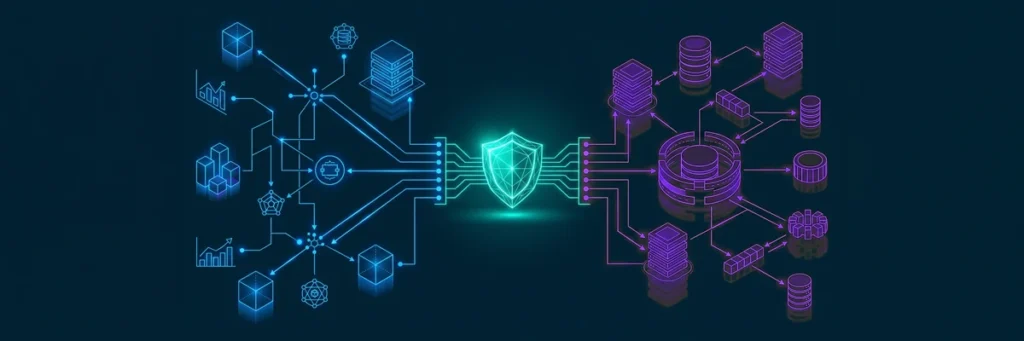
The coexistence of deterministic (traditional) software and probabilistic (AI) software requires specific integration patterns to prevent bottlenecks and cascading failures.
2.1. Traditional vs. AI/ML/GenAI Integration Patterns
Synchronous Integration (REST/gRPC)
Used when the AI response is immediately required to continue the user flow (e.g., a chatbot or product recommendation in a shopping cart). The challenge is managing latency, especially with heavy generative models.
Asynchronous Integration (Event-Driven)
Ideal for heavy tasks such as processing long documents or retraining models. Uses messaging systems (Apache Kafka, RabbitMQ) to queue requests. The AI service consumes, processes, and publishes the result to another topic.
Circuit Breaker and Fallback Pattern
Since AI services can experience instability or rate limits, the architecture must include fallback mechanisms. If the AI fails, the system should return a default response or fall back to a traditional heuristic to avoid disrupting operations.
2.2. Integration with Cognitive Services and ML Platforms
Major cloud providers (AWS, Azure, GCP) offer ready-to-use cognitive services (computer vision, speech-to-text, sentiment analysis).
Using Managed Services
For generic tasks (e.g., extracting text from a PDF via OCR), it is architecturally more efficient to consume a cognitive service API than to train and maintain a proprietary model.
Machine Learning Platforms (MLOps)
For custom models, tools such as MLflow or Vertex AI manage model versioning, ensuring that the enterprise system always consumes the most accurate and up-to-date version through stable inference endpoints.
CHAPTER 3
Building Solutions with Generative AI

Generative AI (GenAI) has opened a new spectrum of possibilities for intelligent automation and human-computer interaction.
3.1. Use Cases and Architecture
Assistants and Copilots
Unlike decision-tree-based chatbots, copilots use LLMs to understand user context and generate dynamic responses. The architecture requires state management (conversation memory) and integration with internal tools (via function calling) so the assistant can execute actions (e.g., scheduling a meeting in the ERP).
Semantic Search and Recommendation
Traditional systems search by exact keywords. Semantic search uses AI to understand the intent behind a query. This is achieved by converting the product catalog or knowledge base into mathematical vectors (embeddings), enabling conceptually similar results to be found even when the exact words differ.
Classification and Information Extraction
LLMs excel at reading unstructured contracts, emails, or reports and extracting specific entities (names, values, dates) into structured formats (such as JSON), which can be readily consumed by relational databases or RPA (Robotic Process Automation) systems.
CHAPTER 4
Solution Architecture with LLMs, RAG, and Embeddings

Large Language Models (LLMs) are the foundation of Generative AI, but their application in enterprise environments requires an architecture that mitigates their limitations, such as “hallucination” and a lack of company-specific knowledge. This is where the Retrieval-Augmented Generation (RAG) pattern becomes essential [1].
4.1. LLMs and Their Enterprise Limitations
LLMs such as GPT-4, Claude 3, or Gemini 1.5 Pro are trained on vast volumes of public data, granting them impressive general knowledge. However, they do not have native access to a company’s internal and proprietary knowledge. Relying solely on an LLM’s pre-trained knowledge can lead to inaccurate or fabricated responses (hallucinations), which is unacceptable in mission-critical systems [1].
4.2. The Retrieval-Augmented Generation (RAG) Pattern
RAG is an architecture that enables LLMs to access and ground their responses in external, trustworthy data sources. It operates in a cycle of four main steps [1]:
- Ingestion: Corporate documents (manuals, reports, knowledge bases) are split into small fragments (chunks). These fragments are then converted into high-dimensional numerical representations called embeddings.
- Storage: The embeddings are stored in Vector Databases (e.g., Qdrant, Pinecone, Weaviate), which are optimized for efficient similarity search across vectors [1].
- Retrieval: When a user poses a question, that question is also converted into an embedding. The vector database is queried to find the document fragments most semantically similar to the user’s question.
- Generation: The retrieved fragments are then injected into the LLM’s prompt as additional context. The LLM uses this context to generate an accurate, grounded response, significantly reducing hallucinations and enabling citation of original sources [1].
4.3. Embeddings and Vector Search
Embeddings are the key to semantic search. They capture the contextual meaning of words and phrases, allowing the system to find relevant information even when the exact query terms are absent. For example, “policy cancellation” may be semantically close to “voided invoice” [1].
Vector Databases are the infrastructure component that stores and enables efficient querying of these embeddings. Choosing the right vector database requires considering scalability, search performance (especially for large data volumes), and the ability to filter by metadata [1].
4.4. Inference Pipelines and Prompt Orchestration
An AI inference pipeline refers to the sequence of steps a model executes to produce an output from a given input. In LLM-based architectures, this may include prompt preprocessing, embedding service calls, vector database lookups, final prompt construction, and the LLM call itself [2].
Prompt orchestration is the management and coordination of how prompts are constructed and sent to LLMs. This includes techniques such as [2]:
Prompt Engineering
The craft of writing effective prompts to guide the LLM toward desired outputs. This may involve techniques such as Few-shot prompting (providing examples), Chain-of-Thought (instructing the LLM to reason step by step), and structured output formatting (e.g., JSON, XML).
LLM Agents
More advanced systems that allow the LLM to plan, use tools (external APIs), and autonomously execute actions to solve complex tasks, such as interacting with a CRM system or fetching information from the web [2].
Hybrid Search
Combining vector (semantic) search with traditional keyword search to achieve more comprehensive and accurate results.
CHAPTER 5
Governance, Security, and Observability in AI

Large-scale AI deployment in enterprise and mission-critical environments demands rigorous attention to governance, security, and observability to ensure compliance, mitigate risks, and maintain reliability [3].
5.1. Governance and Compliance
AI governance establishes the policies, processes, and accountabilities for the ethical and responsible development and use of AI. In large enterprises, this is critical for:
Regulatory Compliance (LGPD/GDPR)
Ensuring that the use of personal data in AI models complies with data protection laws. This includes anonymization, pseudonymization, and consent management [3].
Ethics and Transparency
Addressing biases in training data, ensuring the explainability of AI decisions (XAI – Explainable AI), and establishing audit mechanisms for automated decisions [3].
Usage Policies
Clearly defining which data may be processed by external AI models (cloud providers) and which must remain on-premise or within self-hosted open-source models [3].
5.2. Security in AI Systems
Security in AI systems goes beyond traditional software security, addressing vulnerabilities specific to the models themselves:
Prompt Injection
Attacks in which malicious users manipulate the prompt to cause the LLM to deviate from its original function or reveal confidential information [3].
Data Leakage (PII)
Preventing personally identifiable information (PII) from being exposed during training, inference, or through LLM responses [3].
Model Extraction Attacks
Reverse engineering attempts to replicate the AI model or extract its training data [3].
AI Supply Chain Security
Ensuring the security of pre-trained models, libraries, and data used in AI development.
5.3. AI Observability
Observability is the ability to understand the internal state of an AI system from its external outputs. It is essential for monitoring performance, identifying issues, and ensuring continuous quality [3].
Model Metrics
Monitoring metrics such as precision, recall, F1-score, and LLM-specific metrics: Hallucinations, Data Drift and Concept Drift, and Inference Latency.
LLM Telemetry
Collecting and analyzing data on LLM usage, including tokens consumed, cost per request, time to first token (TTFT), and response quality (via human feedback or evaluation models) [3].
Tooling
Leveraging observability platforms integrated with AI systems, such as New Relic, Datadog, and specialized LLM tools such as LangSmith or Langfuse [3].
CHAPTER 6
Cost Management and Optimization (FinOps for AI)

The total cost of ownership (TCO) of AI solutions can be significantly high, particularly with the use of LLMs and specialized infrastructure (GPUs). The discipline of FinOps for AI aims to optimize these costs without compromising performance or innovation [3].
6.1. The Total Cost of Ownership (TCO) of AI
The TCO of AI extends well beyond the per-token cost of an LLM. It encompasses [3]:
| Component | Description |
|---|---|
| Infrastructure | GPUs, inference servers, vector storage, and high-availability networking |
| Licensing | LLM API costs, MLOps platforms, and observability tooling |
| Development and Training | Model fine-tuning, RAG pipeline construction, and prompt engineering |
| Operations and Maintenance | Continuous monitoring, periodic retraining, and specialized technical support |
6.2. Cost Optimization Strategies
Prompt Caching
Caching responses to frequently repeated prompts, avoiding unnecessary LLM calls and reducing per-token costs.
Smaller Models (SLMs – Small Language Models)
Using Small Language Models for simpler tasks, reserving larger LLMs exclusively for complex cases that genuinely require greater capacity.
Model Quantization and Pruning
Techniques for reducing model size without significant accuracy loss, lowering memory requirements and accelerating inference.
Context Window Management
Controlling the size of the context window sent to the LLM, including only the most relevant information for the task at hand.
Real-Time Monitoring
Implementing dashboards for cost per request, per user, and per feature to continuously identify optimization opportunities.
CHAPTER 7
Deploying AI Features in Production Products

Integrating AI into existing production products requires a careful approach to minimize disruption and maximize value. The key is incremental delivery and continuous validation.
7.1. Incremental Approach
Automation Features
Starting by automating repetitive, low-risk tasks — such as classifying support tickets or drafting email responses — before moving on to more critical automations.
Personalization
Rolling out personalized recommendations and experiences progressively, validating impact on business metrics such as engagement and conversion before scaling.
User Assistance
Introducing AI assistants as support tools (copilots) before granting them full autonomy, keeping users in control during the adoption phase.
7.2. Continuous Testing and Validation
A/B Testing
Comparing the performance of the AI-powered feature against the traditional approach across segmented user groups, using business metrics as the success criterion.
Feedback Loop
Collecting user feedback on the quality of AI responses (ratings, clicks, session duration) and using these signals to continuously improve the system.
Performance Monitoring
Tracking technical metrics (latency, error rate) and business metrics (user satisfaction, NPS) in real time to detect regressions quickly.
CHAPTER 8
Solution Architecture with Advanced Components

For an AI architect, understanding advanced components and how they fit together is crucial for building state-of-the-art solutions.
8.1. Prompt Orchestration and Inference Pipelines
Frameworks such as LangChain or Semantic Kernel provide the scaffolding for building complex pipelines involving multiple steps, such as:
Chaining
Chaining multiple LLM calls, where the output of one step becomes the input of the next, enabling complex, multi-step reasoning flows.
Routing
Dynamically directing a request to the most suitable model or pipeline based on the task type, complexity, or expected response cost.
Memory
Efficiently managing conversation history and user context to enable coherent, personalized interactions without exceeding the model’s context window limit.
8.2. Integrations with AI Providers
The choice between AI providers (OpenAI, Google, Anthropic) and self-hosted open-source models (Llama, Mistral) depends on factors such as cost, security, performance, and customization requirements.
| Criterion | Cloud Providers | Open-Source Models |
|---|---|---|
| Cost | Pay-per-token, predictable | High upfront infrastructure cost |
| Security | Data processed externally | 100% on-premise data |
| Performance | High-capability frontier models | Variable, hardware-dependent |
| Customization | Fine-tuning limited to available APIs | Full control over training and architecture |
| Maintenance | Managed by the provider | Internal team responsible for updates |
8.3. Semantic Search and Recommendation Systems
The architecture involves:
Embedding Generation
Transforming texts, images, or other data into vector representations using specialized embedding models (e.g., OpenAI’s text-embedding-3-large or open-source models such as Sentence-BERT).
Indexing
Organizing vectors into data structures optimized for similarity search (HNSW, IVF) within vector databases, balancing search speed and memory usage.
Querying
Converting the user’s query into an embedding, searching for the k most similar vectors, and combining the results with metadata filters to return the most relevant items.
Conclusion
The role of the AI-focused Systems Architect in large enterprises is multifaceted and strategic. They not only design the technological infrastructure but also act as a bridge between business needs and the capabilities of artificial intelligence.
Mastering the concepts of solution design, integration patterns, governance, security, observability, cost management, and the nuances of LLM and RAG architectures is fundamental to building AI systems that not only function, but thrive in complex, mission-critical enterprise environments.
References
[1] Raona. (2026, March 6). LLM y bases de datos vectoriales: arquitectura RAG.
Available at: https://raona.com/llm-y-bases-de-datos-vectoriales/
[2] Datacamp. (2026, January 15). LLM Agents Explained: Architecture, Frameworks, and Use Cases.
Available at: https://www.datacamp.com/pt/blog/llm-agents
[3] Opservices. (2026, April 3). LLM Observability: A Guide to Monitoring AI Applications.
Available at: https://www.opservices.com.br/observabilidade-llm/