



Many financial institutions have already experimented with AI agents, but turning a prototype into production takes more than a general usage policy. You need to define the data the agent can access, the limits of its actions, who supervises it and the contingency procedure. Without these definitions, the organization faces two risks: keeping initiatives in experimentation indefinitely, or starting with high-impact decisions, where errors can affect customers and create regulatory exposure.
The first use case does not have to be the most ambitious one. It should deliver verifiable value, rely on prepared data, fit into the teams’ work and allow supervision and rollback. Starting with a task that supports the analyst creates an opportunity to test performance, record failures and mature the controls before extending autonomy to more sensitive decisions.
Choose a frequent, multi-step process with a measurable outcome and a manageable risk, tied to a business priority.
Where the agent earns more than automation
Automation handles the fixed path well. The agent tends to earn more than traditional automation when it has to interpret unstructured information, gather context from several sources and decide how to handle exceptions. For your first launch in about three months, I would prioritize an analysis or recommendation-preparation workflow with human approval, rather than starting with autonomous financial decisions.
In many workflows the right design combines the two, with automation on the standard path and the agent on the exceptions.
Microsoft, for example, recommends using the lowest level of complexity that meets the requirement, because each level adds coordination, latency and cost. AWS, meanwhile, notes that it is common to start from what the model does and invent the use case afterward, and asks that you first define the outcome the agent answers for and where its autonomy ends. Google Cloud, for its part, suggests a bounded project, for one persona and one specific task.
How to evaluate candidates
To put a first agent into production, compare candidates by the risk of the workflow and the evidence of reliability, not only by the quality of the answers. A good candidate is one whose scope, use of data and tools, need for human approval and success criteria can be evaluated before deployment.
An initial list of candidates might include anti-money laundering alert triage, support for onboarding review and customer verification (KYC), or drafting investment memos. These are examples of financial workflows covered in the sources, not recommendations that any of them is ready for full autonomy.
To compare your candidates, give each one a score on the criteria below and document the reason. Use the weights that make sense for your institution:
| Criterion | What to check |
|---|---|
| Value | Is there a clear business metric, such as less manual work or better quality, against a baseline? |
| Fit for an agent | Does the work involve unstructured information or exceptions, or would a fixed rule be more reliable? |
| Data and integration | Is there quality data and feasible access to the systems and tools needed? |
| Risk and oversight | Can you limit actions, route cases to people and prevent irreversible actions without approval? |
| Testability | Are there reference cases and outcomes to measure hits, errors and adversarial situations? |
For the first launch, prefer a workflow in which the agent recommends, classifies or prepares material for review, with clear escalation rules. This limits the initial autonomy and leaves room to evaluate the behavior before expanding permissions.
Difference between deploying and sustaining an AI agent
In the traditional anti-money laundering (AML) process, for example, the volume of alerts is high and most of them are false positives that do not result in a relevant case. Even so, every alert has to be analyzed.
The analyst receives the queue and has to gather, from separate systems, the evidence that justifies closing or escalating. The checks repeat consistently, alert after alert. In our reading, the time spent is concentrated in assembling that context, and the final decision is a smaller share of the effort.
The risk of a relevant alert going unnoticed in the middle of the volume is real, both operationally and from a regulatory point of view.
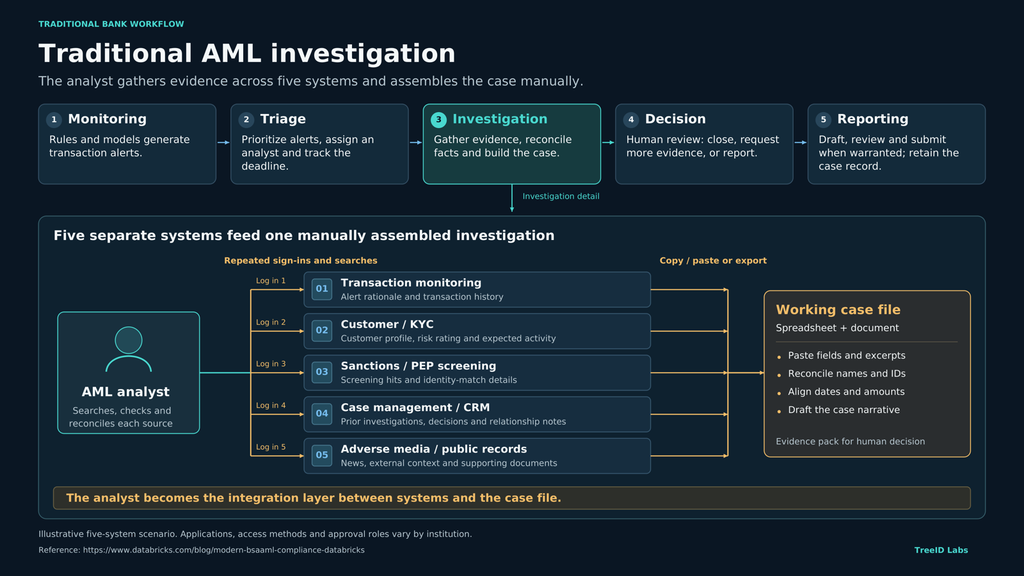
Deploying the agent in this workflow is the most visible part: the agent prepares the dossier and the analyst reviews it.
Sustaining is what comes after, and it takes more work. It requires an identity of its own, a limit on what the agent can query, a record of what it read and what it proposed, periodic review of its access, evaluation of the quality of its proposals and someone responsible when a proposal comes out wrong. Without that, the time gain disappears into rework or into risk discussions.
We showed the SherlockAML lab, from TreeID Labs, in the talk by Roberto Monteiro, TreeID, at APICON. It runs on synthetic AML data: customer profile, transactions, alerts, cases, screening data and links between customers.
A supervisor agent coordinates support agents, one for the case details and another for adverse media, and hands the analyst the assembled case, with the evidence cited. The analyst reviews and decides. A versioned pipeline provisions the agents, so each one's access is described in code, and every step is recorded.
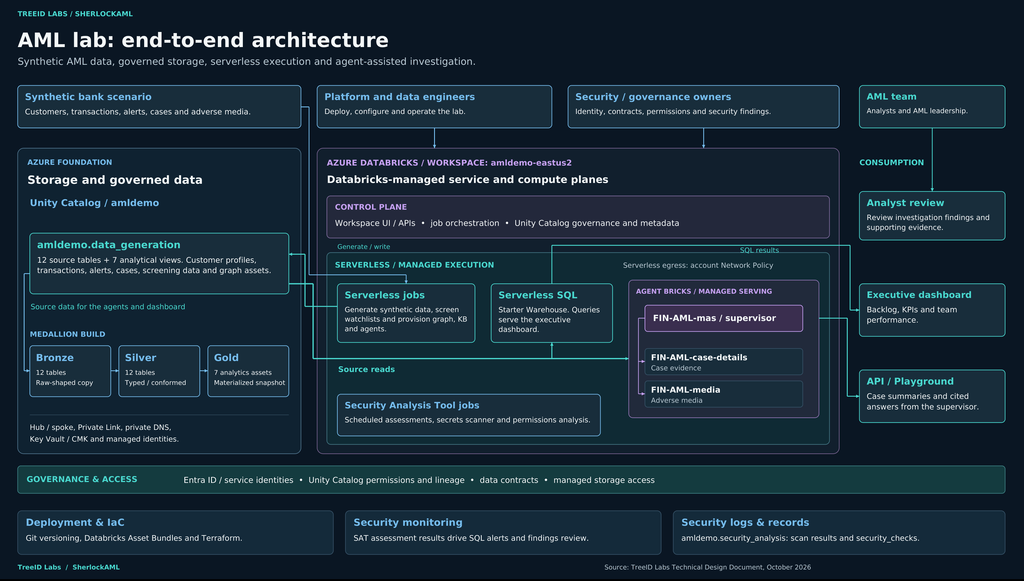
In the full design, the agent is the smallest part of the workflow.
- Deploying means taking the agent from pilot to production with integration, tests, permissions, records, guardrails and responsibilities defined. In finance, the capability of the model alone is not enough: the system has to be monitorable, versionable and auditable.
- Sustaining means keeping the agent useful and safe after it goes into operation: tracking results and incidents, reviewing access, updating integrations and models and controlling costs. Changes in APIs also create ongoing work. For that reason, stable, versioned dependencies make maintenance easier.
In a regulated company, an agent can only be deployed if it can be monitored, versioned and protected by safeguards, and if its decisions can be explained, regardless of how capable its reasoning is.
Choose a first agent only when responsibility can be assigned for both deployment and ongoing operation. Start with a bounded workflow that can be reviewed. Measure the business value and the quality of the outputs. Give the agent only the tools it needs, and increase its autonomy only as the controls and the evidence justify it.
We explain the subject further in the article How Much Autonomy to Give AI Agents.
Frequently asked questions
If the company does not have any agent yet, the safest is a single preparation workflow. If it already has several candidates, bring them all: the order comes from the filter above, and how many to run at the same time depends on the company's work structure.
No. It has to be clear enough to test, supervise and evaluate. What is missing can be written during discovery.
A named person or team, who answers when a proposal comes out wrong, reviews access and tracks the results. If nobody takes on that role, the case is not ready to leave the pilot.
Within 3 months of the project start, we deliver a Working Agent, with acceptance criteria. It goes live if data, identity and integration are ready. If they are not, the delivery ends as a test scenario. The time to write the rule, when it is missing, is not in that count and depends on the company.
Sources