


Understand how AI agents make RAG more adaptive, which components belong in the architecture and what to evaluate before production.
Finding information has always been one of computing’s larger problems. First the systems looked for words, then they began to approximate meaning, and with the arrival of Large Language Models it became possible to return that information as an answer in natural language.
Agentic RAG represents a new stage in that evolution. Rather than simply retrieving documents and handing them to a language model, agentic systems can decide when to search, where to look, how to rephrase a query and whether they already hold enough to answer. Retrieval stops being a fixed step and becomes a tool used dynamically while the problem is being solved.
What agentic RAG is
Agentic RAG is an evolution of Retrieval-Augmented Generation in which AI agents take an active part in retrieval decisions.
In traditional RAG the path is set in advance: take the question, search documents, add the results to the model's context and generate an answer. In agentic RAG the system makes decisions along the way. An agent can identify that it needs to search an internal base, analyze the results, notice that a given piece of information is missing, query another source, rephrase the search and only then produce the answer.
The objective shifts. It stops being retrieving relevant documents and becomes discovering which sequence of actions and sources resolves the question.
From keyword search to agentic RAG
The evolution of RAG ties directly to the history of information retrieval. The earliest search systems were based on matching terms: when a person searched a word, the engine looked for documents containing that same term. Structures known as inverted indices made the process extremely efficient, and algorithms such as TF-IDF and BM25 came to help rank results by the importance and frequency of the terms found.
That model remains useful, especially for searches involving a code, a product name or an exact phrase. The important limitation lies elsewhere: identical words do not necessarily carry identical intent, and similar concepts can be expressed with completely different words.
The arrival of semantic search
Semantic search widened what retrieval systems could do. Rather than representing a query only by its words, models began converting text into numeric representations called embeddings, which aim to capture semantic characteristics of the content. Related terms and phrases tend to occupy nearby regions of vector space.
That lets the engine find semantically related information even when the document does not use the query's exact words. A person searches for a concept with one expression and finds documents describing the same idea in different terminology. The advance was fundamental to much of modern AI architecture.
Lexical and semantic search are complementary
Semantic search did not remove the need for traditional search, because the two approaches carry different advantages. Lexical search is very effective at locating a contract number, a product identifier or an exact technical term. Vector search stands out when intent and meaning weigh more than exact word matching.
That is why modern architectures frequently use hybrid search, combining lexical and semantic mechanisms. The combination also became important in the evolution of RAG systems.
The arrival of LLMs
Large Language Models changed how people interact with information. Rather than receiving a list of documents, it became possible to ask a question and get a direct answer in natural language.
But an LLM has one important characteristic: it does not work as a query mechanism against external information. The model produces answers using patterns learned in training and the context received at that moment. The difficulty shows up when the information needed sits in an internal document or a private base that fell outside that training. Bringing generation and retrieval closer together is exactly why Retrieval-Augmented Generation gained ground.
What RAG is
RAG stands for Retrieval-Augmented Generation. The central idea is to supply the language model with information retrieved from an external source before the answer is generated.
In a basic architecture the user asks a question. The system looks for relevant content in a knowledge base, the retrieved documents enter the context sent to the model, and the answer is generated from them. That approach connects language models to information specific to the company without requiring full retraining. The corporate application of this layer is covered in RAG in the corporate environment.
The concept gained academic visibility with Retrieval-Augmented Generation for Knowledge-Intensive NLP Tasks, published in 2020.
How traditional RAG works
A basic pipeline starts with document preparation. Long content is split into smaller parts, called chunks, and those fragments are converted into embeddings and stored in a vector retrieval mechanism. When a query arrives, the system looks for the passages most related to the question and sends that material to the model as context.
The process can be represented simply:
Question → retrieval → relevant documents → LLM → answer
The architecture is simple and works well for many applications. The problem appears when the question requires more than one search.
The limits of traditional RAG
Traditional RAG is built as a predefined flow: the query comes in, a set number of results is retrieved, and the context goes to the model. Not every question resolves that way.
Imagine a request that depends on data held in three different systems. Perhaps the first result reveals that a second query is needed. Perhaps two sources present contradictory information, or the original search was poorly phrased. A rigid pipeline cannot change strategy based on what it discovers during execution, and that is the point where more advanced techniques start to appear.
How RAG evolved before agents
The evolution did not go straight from a simple pipeline to autonomous agents. Several techniques emerged to improve retrieval. Query rewriting rephrases the user's query before the search. Query expansion adds terms that widen coverage. Hybrid retrieval combines lexical and vector search. And rerankers reassess the documents initially retrieved, reordering them by relevance to the question.
What changes with agentic RAG
With agentic RAG, retrieval becomes part of a decision-making system. The agent analyzes the question and chooses which resources to use. It can decide to retrieve nothing when retrieval is unnecessary. Among different bases, it can choose one, rephrase the query, and run several searches. It can also call an API and compare two sources. And it can assess whether the evidence is sufficient before generating the final answer.
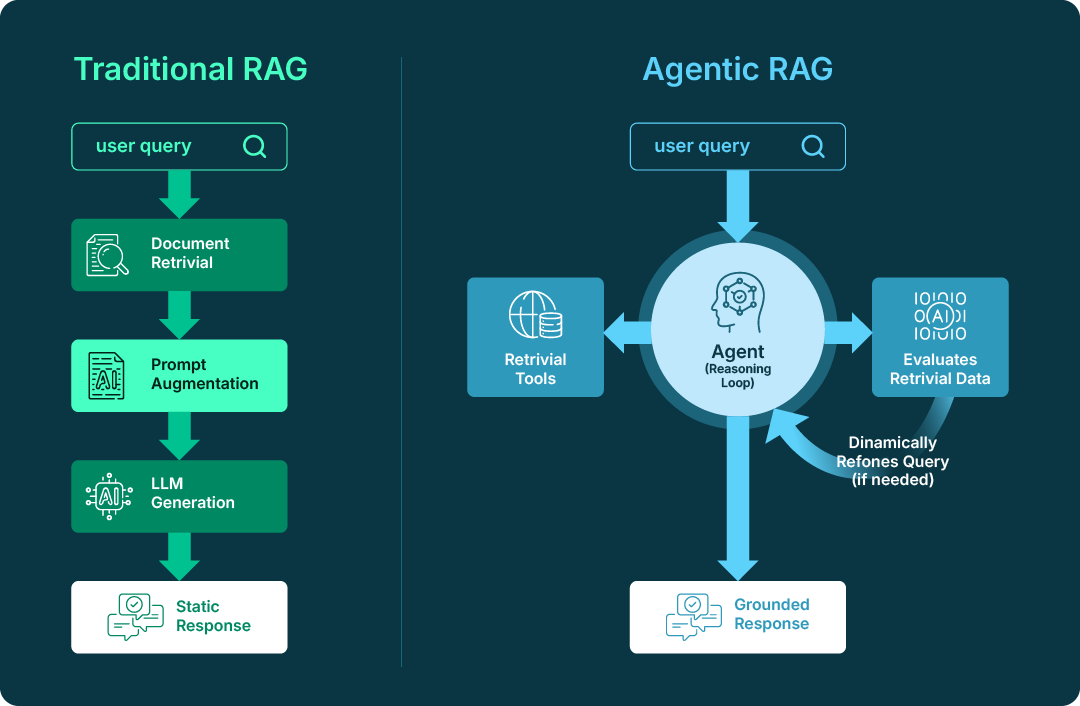
That architecture connects directly to the evolution of AI agents, which brings its own challenges of scale and governance, covered in how to scale AI agents in banking.
Traditional RAG and agentic RAG, side by side
| Operation Dimension | Traditional RAG (Direct Semantic Search) | Agentic RAG (ReAct Loop + APIs) |
|---|---|---|
| How the system executes the task | Tries to search the vector database all at once for terms like "revenue decline" and "complaints." | Dynamic Iterative Loop: 1. Queries the corporate financial API to list quarterly sales. 2. Identifies Product X as the detractor. 3. Triggers a refined vector search focused strictly on customer complaints about Product X. |
| Estimated Production Latency | Stable: ~1.5s to 3.0s total. (Only one inference call to the LLM). | Variable: ~8.0s to 20.0s total. (Multiple sequential LLM calls to decide steps and interpret tool results). |
| Token Consumption and Cost | Low and Predictable: Sends the user prompt + top-K retrieved chunks a single time. | High and Cumulative: Each iteration of the ReAct cycle (Thought-Action-Observation) needs to resend the entire previous reasoning history to maintain context. |
| Failure Mitigation Mechanism | Simple: Chunking optimization, use of rerankers, or query rewriting. | Critical (Requires Software Engineering): Circuit Breakers: Hard limit on iterations (e.g., max_loops = 4) to prevent infinite processing loops if the LLM fails to interpret an API error. Fallback logic: If the agentic search fails, the system falls back to a deterministic flow. |
The difference sits mainly in who controls the retrieval process, and a more powerful model does not settle it.
How an agentic RAG architecture works
An agentic RAG architecture combines components with distinct roles. The language model takes part in interpreting the request and in generation. The agent organizes the actions. Retrievers look for information across sources, and lexical and vector search mechanisms locate the documents. Rerankers reorder the results. APIs give access to external systems, memory preserves context between steps, and evaluation mechanisms help determine whether the evidence found is enough to move on.
In an enterprise setting all of that structure has to talk to the systems and to the access policies. That is why agentic RAG is not an isolated chatbot feature: it belongs to a wider AI systems architecture.
The role of APIs
An agent may need to query far more than documents stored in a vector database. Depending on the question, the information needed sits in a CRM, an ERP, a data lake or an external service, and that is where APIs take a central role.
The agent uses a tool to query a system and, depending on the result, decides what the next step will be. That makes API integration a relevant component of enterprise agentic architecture. Phrasing the right question is half the work. The other half is reaching the right source safely.
A practical example
Consider this question: which product showed the largest revenue drop this quarter, and which customer complaints help explain the result?
A linear RAG would try to find documents related to the whole query. An agent takes another route. It first queries the sales base and identifies the product with the largest drop. With that information, it searches service records tied specifically to that product and looks for patterns in the complaints. If needed, it queries another source to validate. Only then does it consolidate the evidence and generate the answer.
That ability to break a problem apart and adapt the path of investigation is one of the main differentiators of agentic RAG.
Does agentic RAG remove hallucination?
No. RAG, traditional or agentic, does not guarantee that the answer is correct.
Poor retrieval surfaces irrelevant information. Sources go stale. The model misreads the evidence. And an agent can select an unsuitable tool or close the investigation too early. The advantage of RAG is providing a mechanism to ground the answer in external information, and final quality still depends on the architecture, the sources and the evaluation.
When to use agentic RAG
Agentic RAG becomes interesting when the task requires more than one knowledge source, a query in several steps, dynamic tool selection, comparison across documents, API integration or validation before the final answer.
For simple questions against a single knowledge base, the traditional architecture remains the better choice. Adding agents without need raises cost and latency. The benefit does not follow.
Data remains the central part of the problem.
The more autonomous the agent, the more the available data structure matters. A system only retrieves quality information when the source is organized and governed. In enterprise architecture that involves a data lake, a transactional database and distinct processing layers.
The relationship between agents and data architecture appears in data architecture in the age of agents. That is why RAG and agentic AI depend on a solid Data & AI foundation, rather than being an interface project.
The challenge of context leakage and governance
An agent that chooses among multiple tools also needs to know which resources it is authorized to use. Imagine a corporate system capable of querying financial data, personnel data, and CRM. Retrieval cannot ignore the permissions of the person who made the request. Otherwise, the agent finds and uses information that person should not have access to.
Autonomous agents that consume APIs from multiple corporate systems inherit a critical risk: privilege escalation and the leakage of confidential data. If an agent has read access to the financial ERP and the HR database, a regular chatbot user may, intentionally or not, extract salary data through the agent.
To mitigate this at the production level, the architecture must integrate granular end-user IAM (Identity and Access Management) control directly into the agent's tool-calling sessions (passing scoped "on-behalf-of" authorization tokens), in addition to input and output sanitization layers such as DLP (Data Loss Prevention) for automatic masking of PII (personally identifiable information) before the information reaches the LLM's context window.
Identity and authorization become architectural components. The problem is detailed in Agentic Enterprise: identity and integration with AI agents. The greater the autonomy, the clearer it has to be what each agent may query and execute.
How to evaluate an agentic RAG
Unlike traditional RAG, Agentic RAG works as a dynamic ecosystem in which the agent uses a reasoning-and-tools cycle to decide autonomously how to act. For that reason, trying to evaluate the system only by checking whether the "final answer looks good" is an incomplete approach that hides structural failures invisible at the surface.
To measure the real quality of an Agentic RAG solution, it is essential to break the evaluation into specific dimensions, analyzing both the data flow and the agent's logical behavior.
Dimension 1: The Classic Grounding Triad
Before evaluating the agent's decisions, we need to ensure the technical efficiency of the three stages that make up the basic grounding mechanism:
- Retrieval: Evaluates the system's ability to search for relevant documents and passages in structured or unstructured knowledge bases, such as corporate vector databases or repositories. The metric focuses on the semantic precision of the search, ensuring that the information retrieved is highly relevant to the user's query.
- Augmentation: Evaluates how the retrieved information is incorporated into the prompt sent to the large language model (LLM). If augmentation fails or omits data, the model will be forced to answer using only its static training knowledge, defeating the purpose of RAG and sharply increasing the risk of outdated answers or hallucinations. Augmentation should also be optimized to fill the context window in a balanced way, avoiding excessive processing costs.
- Generation: Evaluates the LLM's ability, as the agent's brain, to process the augmented instruction and formulate a fluent, empathetic and contextually appropriate final answer in natural language. Generation should be assessed for factual accuracy and transparency, ideally citing the specific sources used.
Dimension 2: The Agentic Reasoning Cycle
In an Agentic RAG system, the LLM is not only a passive generator; it controls the process through an iterative reasoning cycle, such as the ReAct framework, to interact with the environment. Two new decision fronts should be evaluated in this dimension:
- Search decision, reasoning and tool selection: Evaluates the agent's judgment when deciding whether it needs external information. Simple queries or direct greetings should be resolved without triggering search tools unnecessarily, saving processing, while complex questions should precisely activate the right tools and data connections to ground the answer.
- Dynamic iteration, evaluation and internal refinement: Unlike static systems, the agent continuously evaluates its own progress. If it detects that the information obtained in the first retrieval is insufficient, it should be able to iterate: refine search terms, access an alternative data repository or ask the user for clarification before moving to final generation. This dimension evaluates the efficiency of that loop and the stopping logic needed to avoid infinite cycles.
Dimension 3: Operations, MLOps and Observability Metrics
Taking Agentic RAG to production requires technical evaluation to be closely accompanied by robust MLOps practices and continuous observability:
- Latency: The total response time perceived by the end user, a critical factor when the agent executes multiple iterative cycles of reasoning, search and tool calls.
- Cost and call volume: Financial control based on request volume, compute time and the count of input and output tokens generated by the agent's iterations.
- Degradation monitoring: The use of tools to monitor the deployed model's performance over time, detecting deviations or input drift in user queries so updates or periodic retraining can be triggered proactively.
Agentic RAG and enterprise architecture
In a prototype it is relatively simple to connect a model to documents. The challenge grows when the goal is running in production, because the architecture then has to handle availability, cost, integration and model evolution. This is where the RAG discussion meets systems engineering.
The question stops being which model to use. It becomes which sources will be reached, who holds permission, how the answer will be evaluated and how the system will be observed in production. That systemic view is what turns an AI experiment into a sustainable enterprise application.
The future of RAG is more adaptive
The history of information retrieval shows a consistent evolution. First the systems looked for words, then they began to approximate meaning. With LLMs, they began to generate answers. RAG then gave them access to external knowledge. Now, with agents, they begin to decide how to use that knowledge to solve a problem.
That does not oblige every application to use agentic RAG, and traditional pipelines will remain simpler and more suitable for many cases. The main change is that retrieval stops being necessarily a rigid step and becomes a capability used dynamically during execution.
The challenge for the next generation of AI systems lies in building systems that know what to look for, where to look, and when they have found enough evidence to answer.
Frequently asked questions
Agentic RAG is an architecture that combines Retrieval-Augmented Generation with AI agents able to decide dynamically how and when to retrieve information.
In traditional RAG the retrieval flow is predefined. In agentic RAG the agents choose sources, rephrase queries, run several searches and use different tools before generating the answer.
No. Traditional systems remain suitable for many applications, and agentic RAG is particularly useful when the problem requires multiple steps, several sources or an intermediate decision.
Yes. Depending on the architecture, agents use APIs, databases, search engines and documents as part of the retrieval process.
It can be. Several searches, model calls and additional tools raise cost and latency, which is why the architecture should be chosen according to the real complexity of the problem.
Building an application with RAG and agents involves more than connecting a language model to documents. It requires integrating data, APIs and models into an architecture ready for production, with security and observability designed in.
TreeID's Data & AI practice designs that layer across the components the institution already runs, and delivers the design on record, with an owner and a review criterion, before the initiative scales.
Get your free AI Readiness diagnostic
Building applications with RAG and agents involves more than connecting a language model to documents. It requires integrating data, APIs, and models into an architecture prepared for production, with security and observability built in from the design stage.
TreeID's Data & AI practice designs this layer on top of the components the institution already operates, and delivers the documented design, with an owner and review criteria, before the initiative scales.
Take the opportunity to complete the maturity self-assessment for adopting AI agents in production. The questionnaire identifies governance gaps, technical dependencies, and operational risk points across four layers: data, integrations, applications, and observability. With the results, the organization defines what to prioritize before expanding the agents' autonomy