


As AI agents begin to carry out tasks and interact with corporate systems, the question is no longer only what the technology can do. The most important decision is what the organization is prepared to delegate.
Imagine an AI agent that supports an anti-money laundering (AML) team. It queries data, gathers transaction history and prepares recommendations for alert review.
After hundreds of cases, its recommendations are accepted with few changes. A question then arises: why not let the agent carry out some tasks on its own?
The answer depends less on the accuracy rate and more on the consequences of an error.
An agent that attaches the wrong document can have its action reversed. A decision that affects an account or a regulatory obligation calls for a different degree of control.
Autonomy, therefore, should not be defined for the agent as a whole, but for each action it can perform.
Separate capability from authority
An agent’s technical capability is not the same as authorization to act.
A model may be able to query information, update records and trigger systems. That does not mean all of these operations should be available without supervision.
For organizations, the implication is clear: autonomy must be treated as a decision to delegate authority, not as a model setting.
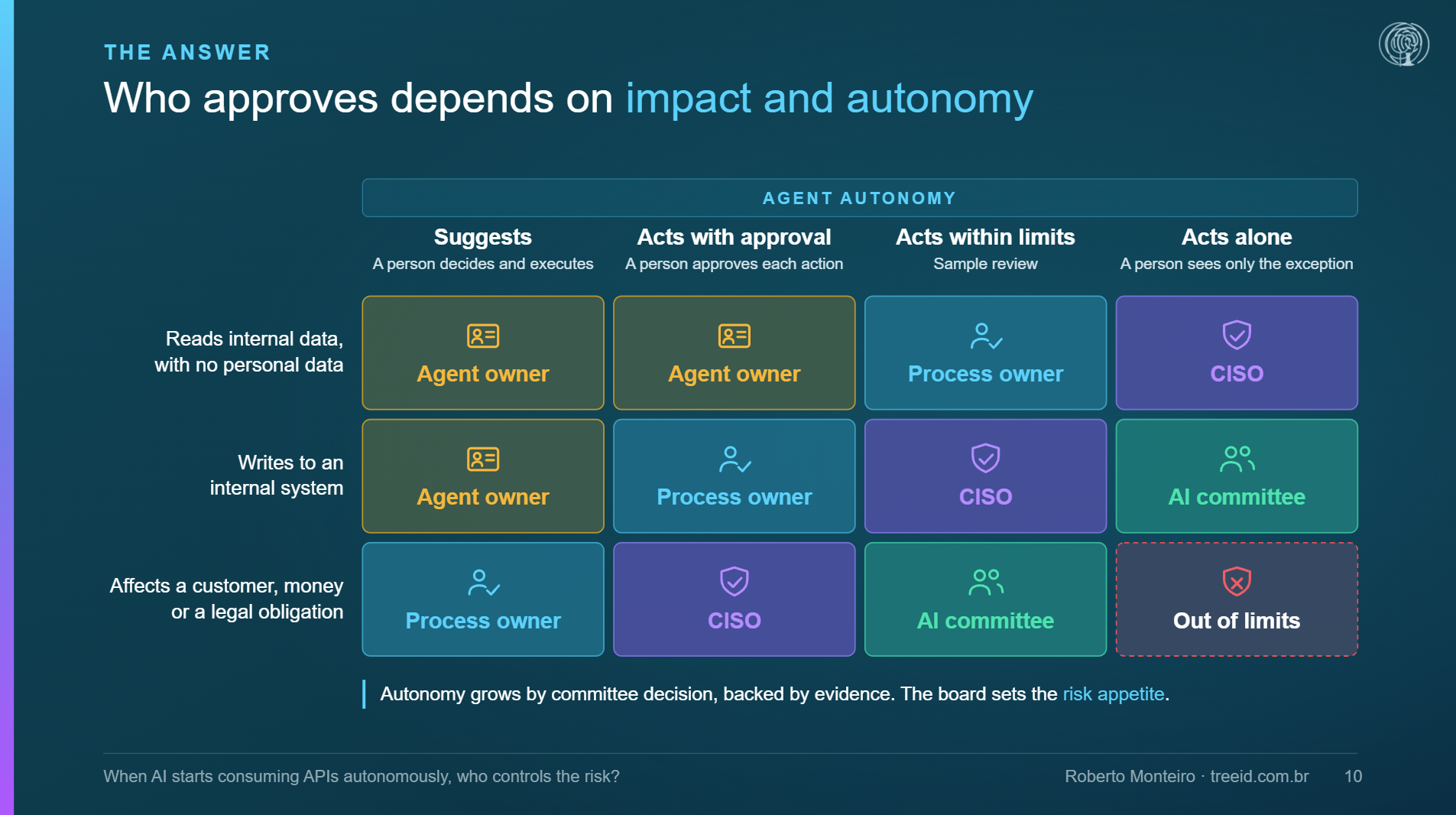
How to plan an agent’s level of autonomy
1. What is the impact of a failure?
The first question is simple: if the agent makes a mistake, what is the consequence?
The answer should consider the effects on customers, operations and regulatory obligations. The greater the potential impact, the less autonomy should be granted without prior supervision.
In AML, for example, preparing a case has a different risk profile from closing an alert, reporting a suspicious transaction or blocking an account.
2. Does the agent respect its limits?
Autonomy does not depend only on the agent producing good answers. It depends on the agent operating within its authorized scope.
This requires tests of permissions, data and consumption, with recorded results. The organization must show that the agent accesses only what it should access, executes only what it may execute and stops acting when it leaves the approved scenario.
3. Can we stop it?
No agent should operate with relevant autonomy without clear mechanisms to block, pause and revoke.
This control cannot exist only in theory. It must be demonstrated in the scenario being assessed.
In other words: granting autonomy also presupposes the ability to withdraw it quickly.
4. Can we explain what happened?
Autonomy requires traceability.
The organization must be able to reconstruct the agent’s behavior from records of its actions, the authorization it received, the calls it made and the result it produced.
Without this, it is hard to investigate incidents, review decisions or justify widening permissions.
What do these questions change in practice?
They help replace an abstract discussion about “levels of autonomy” with a more objective decision: is there enough evidence to let the agent perform this action in this context?
For an AML team, the answer may be yes for activities such as querying information, preparing the case or recording reversible steps.
But the same answer may remain no for decisions with regulatory effect or direct impact on customers.
This is the central point: autonomy does not need to be total to create value.
Autonomy should grow with the evidence
Maturity in the use of AI agents is not measured by the number of automated tasks, but by the ability to show why each permission was granted.
The expected evidence is clear:
- assessment of the impact of failures
- tests that the agent respects its limits
- demonstration of blocking, pausing and revoking
- records that explain what happened
This evidence supports the decision on how much autonomy to allow and who can approve it.
The maturity of an operation with AI agents is not measured by the number of automated decisions, but by the ability to show why each one of them can be delegated.
Where to start?
Start with a single action in your process and assess four points:
- what the impact of a failure would be
- how to test whether the agent respects its limits
- how to stop it from acting
- how to record and explain what happened
This exercise tends to be more useful than discussing autonomy in the abstract.
In the TreeID Fit Session, we do this analysis from a real workflow in a 45-minute session.
Prefer to start on your own? Try the Agentic Readiness Check.